
Career opportunities
CONTENTS
Introduction to Hospital Pharmacy
Overview of the Hospital Pharmacist position
.jpg)
Job Title
Hospital Pharmacist
Overview
A hospital pharmacist is responsible for the professional management of medications in a healthcare facility (including hospitals, medical centers at all levels and clinics).
Hospital pharmacists ensure the safe and rational supply, storage, distribution and use of medications, supporting patient treatment.
Hospital pharmacists may participate in various activities within the hospital pharmacy department, such as pharmaceutical operations, inventory management, dispensing, clinical pharmacy work, drug information, pharmacovigilance and pharmaceutical statistics.
This is a crucial position in the pharmaceutical industry in particular and the healthcare industry in general.
Main Responsibilities
Planning the supply of medications and consumable medical supplies for the entire hospital.
Dispensing, storing and inventorying medications according to regulations.
Participating in the organization and evaluation of tenders.
Specialized drug preparation (oncology, pediatrics, traditional medicine, etc.).
Participating in consultations, advising on drug use, monitoring drug interactions and side effects.
Performing clinical pharmacy: supervising prescriptions, ensuring rational drug use.
Participating in scientific research, training and guidance.
Statistics and reporting, participating in the Drug and Treatment Council.
Managing specialized equipment and pharmaceutical software (HIS, eRx, etc.).
Required Qualifications and Skills
Necessary skills:
- In-depth understanding of pharmacology and clinical pharmacy.
- Effective consulting, communication and teamwork skills.
- Meticulousness, accuracy and adherence to professional procedures.
- Research, supervision and professional training capabilities.
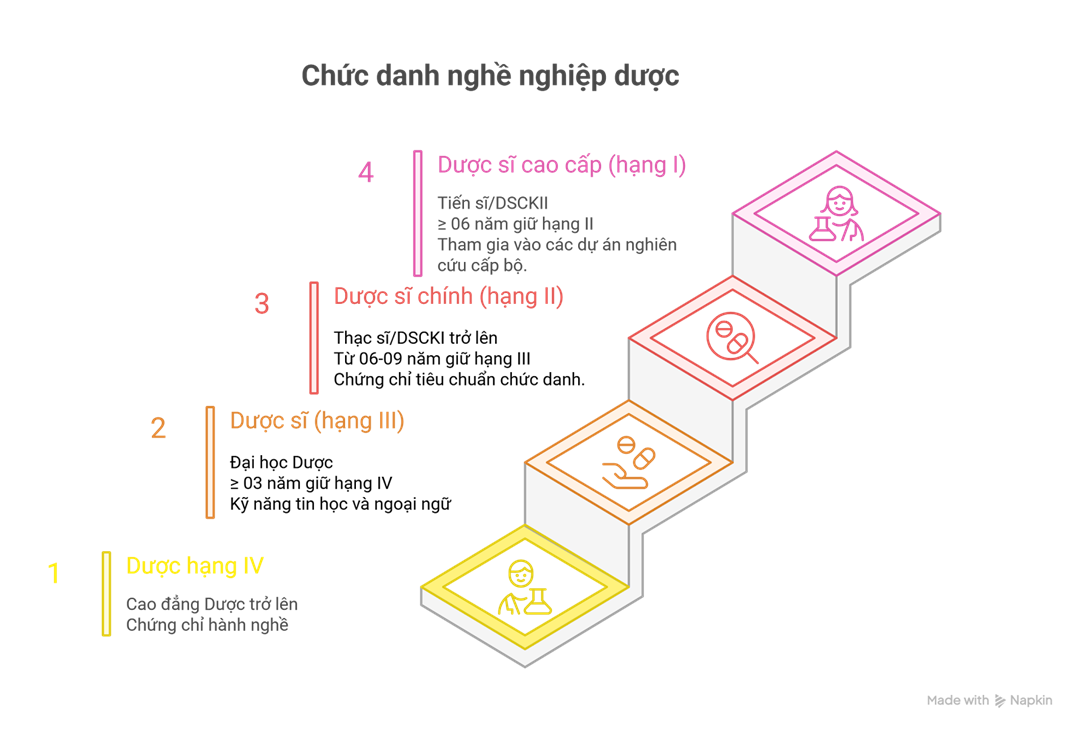
For public healthcare facilities, the required qualifications for the pharmacist professional title are as follows*:
Pharmacist Grade IV: College degree in Pharmacy, no experience required, professional practice certificate needed.
Pharmacist (Grade III): University degree in Pharmacy, at least 3 years holding Grade IV or equivalent professional title (including at least 1 year in Grade IV Pharmacy), basic computer and foreign language skills required.
Principal Pharmacist (Grade II): At least 9 years for Master's/Specialist Pharmacist Level I and at least 6 years for Doctorate/Specialist Pharmacist Level II holding Grade III or equivalent professional title (including at least 1 year in Grade III Pharmacy), professional title standard certificate required.
Senior Pharmacist (Grade I): Doctorate/Specialist Pharmacist Level II, at least 6 years holding Grade II or equivalent professional title (including at least 1 year in Grade II Pharmacy), participation in research projects at the ministerial level or higher.
*Note:
Please refer to Joint Circular 27/2015/TTLT-BYT-BNV and Circular 03/2022/TT-BYT for further information.
For private medical facilities, the qualification requirements are similar to the above, but the professional titles are not clearly distinguished and usually depend on the size of the facility.
Salary and Benefits
Grade IV: 7–8 million VND/month.
Grade III: 8–12 million VND/month.
Grade I or Clinical and Management: >15 million VND/month.
Insurance: Social insurance, health insurance, unemployment insurance.
Lunch allowance, transportation allowance, responsibility allowance.
12–16 days of annual leave, holiday bonuses.
For private medical facilities, salaries may be higher depending on the agreement between the facility and the employee.
Career Development Opportunities
Clear career advancement path: IV → III → II → I (for public medical facilities)
Possibly become Head of Pharmacy Department, Chief Clinical Pharmacist and participate in teaching practical courses in the hospital-university model.
Opportunities to pursue Master's or Doctoral degrees, or shift towards management or pharmaceutical practice.
Participating in scientific research and training students in the medical and pharmaceutical fields.
Common workplaces:
Public hospitals from district to central level.
Specialized hospitals: ophthalmology, pediatrics, oncology, obstetrics, etc.
International hospitals, multi-specialty clinics.
Advice from experienced pharmacists:
"Master pharmacology and clinical pharmacy from the beginning."
"People think pharmacists only sell medicine, but in a hospital, you are the one controlling the quality of treatment."
"Strive to improve your knowledge, foreign language skills, and communication skills. Working in a hospital requires not only strong professional expertise but also a compassionate heart."
"If you want to advance, invest in higher education and participate in research and professional councils."
Nguyen Chi PharmD – Hospital pharmacist (1 year of experience): “Having a lot of knowledge, I'm afraid of making mistakes. But being recognized for my value is very precious.”
Lay A Cau PharmD – Hospital Pharmacy Department (over 10 years of experience): “You need to be highly skilled in your field, possess soft skills, technological proficiency and foreign language skills. Patient trust is key to success.”
Nguyen Thi Kim Hoa PharmD – Hospital Pharmacy Pharmacist (20 years): “You have to study both medicine and pharmacy. Outsiders might think it's easy, but in reality, it's extremely stressful because it directly relates to patients' health.”
Job Description and Roles of Each Pharmacy Job Title
1. Pharmacist Grade IV (Code: V.08.08.23)
Responsibilities:
Prepare, dispense, and store common medications, chemicals and medical supplies.
Assist in preparing simple medications and traditional medicine.
Assist higher-level pharmacists in specialized medication preparation.
Participate in biochemical testing and drug testing.
Record, compile and report drug side effects.
Manage records, drug inventory and compile reports.
Role:
1. Pharmacy Technician. Working in the dispensing warehouse, pharmacy, or assisting senior pharmacists.
2. Pharmacist (Grade III) (Code: V.08.08.22)
Responsibilities:
Supplying, storing, dispensing and using medications within the unit.
Combining medications according to the requirements of each specialty.
Monitoring prescriptions and the rational use of medications.
Ensuring the quality of compounded medications.
Monitoring and reporting adverse drug reactions (ADRs) and drug resistance.
Participating in the development of technical procedures and instructions for the use of specialized equipment.
Role:
Principal Pharmacist. Assigned to the Pharmacy Department, pharmacy, clinical pharmacy and drug warehouse.
3. Senior Pharmacist (Grade II) (Code: V.08.08.21)
Responsibilities:
Leading professional activities in the Pharmacy Department.
Managing drug supply, bidding, and monitoring rational drug use.
Checking drug quality and compounding procedures.
Guiding the training of new pharmacists and interns.
Leading statistical reporting and pharmacovigilance.
Participating in consultations and antibiotic control.
Role:
Middle-level pharmacist. May be a team leader or deputy head of the Pharmacy Department.
4. Senior Pharmacist (Grade I) (Code: V.08.08.20)
Responsibilities:
Leading all pharmacy activities in the hospital.
Developing and supervising the implementation of professional regulations on pharmacy.
Leading a Ministry-level scientific research project.
Managing equipment and facilities in the pharmacy sector.
Directing and evaluating the professional activities of lower-level facilities.
Advising the hospital director on pharmacy matters.
Role:
Head of the Pharmacy Department or senior specialist. The role involves leading and coordinating all pharmaceutical work at the facility.
